Upload your syllabus, readings, and lecture recordings. Fabric becomes a personal AI tutor grounded in your specific course materials, not generic knowledge from the internet. Every answer cites the page, the slide, or the timestamp.
Your materials. Your tutor.
Grounded in your course.
Your AI tutor answers from your uploaded syllabus, your assigned readings, your lecture transcripts, and your notes. Ask it to explain a concept and it uses your lecturer's framing from the transcript. Ask it to find a passage for your essay and it cites the exact page from the exact reading.
Memory across sessions.
Your AI tutor remembers what you have studied, what you have asked, and what you have struggled with. It does not reset with every conversation. Over time, it adapts to your learning in the same way a human tutor builds understanding of a student.
Multiple AI models.
Choose from Gemini, Claude, GPT, and other models depending on the task. Different models have different strengths, and you can switch between them within the same workspace.
Record every lecture. Search any moment.
Bot-free lecture recording.
Record any lecture, in person or remote, using AI voice notes. No meeting bot joins your call. No awkward consent conversations. Hit record on your laptop or phone and the full lecture is transcribed with timestamps.
Your notes and the transcript, merged.
If you take notes during the lecture, your notes and the AI-generated transcript are combined into a single document. What you thought was important and what the AI captured sit side by side, searchable and complete.
Search by what was said.
Ask "when did we cover the Krebs cycle" or "the part about supply elasticity" and find the exact timestamp from the exact lecture. Search works by meaning, so it finds the right moment even when the professor used different phrasing from what you remember.
All your course materials in one searchable place.
Every format, one library.
Slides from the course portal. Readings as PDFs. Textbook chapters as ebooks. Articles from the reading list. Notes from seminars. Photos of the whiteboard. All in one workspace per course, searchable across every format. No more remembering which app or folder has the file you need.
Search by meaning, not filename.
Smart search reads inside every PDF, slide deck, ebook, note, and transcript. "The reading about cognitive load theory" finds the PDF. "My notes from the week 6 seminar" finds the note. "The diagram from the lecture slides about cell division" finds the slide.
Organised automatically.
Smart organization tags materials by content and topic without manual filing. Group materials by module or week using spaces. Sync across devices so notes from your laptop are searchable on your phone.
Why this is different from ChatGPT.
ChatGPT answers from its training data. It might know the broad outlines of your subject, but it has not read your syllabus, your readings, or your lecture transcripts. It does not know that your week 4 reading argues something the week 6 reading contradicts, and that working through that contradiction is the point of the essay due Friday.
Your Fabric AI tutor answers from your materials. The specific reading your professor assigned, not a general summary of the topic. The specific lecture where a concept was explained, not a textbook definition. Every answer cites a source you can verify: the page, the slide, the timestamp. This distinction matters most for university courses with specific readings, particular theoretical framings, and lecturers who emphasise different things from the textbook. See a detailed comparison of Fabric and ChatGPT.
The two sigma effect, at scale.
In 1984, Benjamin Bloom found that students who received one-on-one tutoring performed better than 98% of students in conventional classrooms. The problem was that one-on-one tutoring requires one teacher per student, which no education system can afford. In June 2025, a Harvard randomised controlled trial found that students learned roughly twice as much per hour with an AI tutor as with Harvard's own active-learning classroom.
The AI tutor worked because it captured the same mechanisms that make human tutoring effective: immediate feedback, adaptive pacing, active recall, and Socratic questioning. But most AI tutors have a gap that Bloom's human tutors did not. They do not know your course. A tutor grounded in your actual materials closes that gap. You can read the full research behind this in the Bloom's two sigma problem guide.
A library that compounds across your degree.
Every lecture you record, every reading you annotate, every note you write deepens the context your AI tutor can draw on. A question asked in your final year draws from everything you have studied across your entire degree. The compounding effect that Bloom observed in one-on-one tutoring, where the accumulated knowledge between tutor and student made each session more effective than the last, has a structural parallel here. Your tutor gets better as your library gets richer. The investment in capturing materials compounds across your degree into a personal knowledge base that no generic AI can replicate.
More than a tutor.
Fabric is not just an AI chat interface. It is the workspace that holds everything. Annotate readings with highlights and comments that are searchable across your library. Read saved articles in the reader for a distraction-free experience. Map essay structure and arrange sources on the canvas. Write essays and coursework in notes and docs with your research searchable alongside the draft. Capture ideas on the go with voice notes, photos, and the mobile app. Collaborate on group projects with shared spaces. Your AI tutor is one part of a complete study system.
Study smarter with your personal AI tutor.
Quiz you on your material.
Ask your AI tutor to test you on a specific lecture, a reading, a module, or the full semester. It generates questions from your actual content, not from a generic question bank.
Explain what you do not understand.
Ask your tutor to explain a concept using your lecturer's framing and the assigned readings. The explanation is grounded in your course, not a generic summary that might use different terminology or take a different theoretical position.
Find connections across your course.
Ask your AI tutor to connect ideas across lectures, readings, and your notes. "How does the concept from week 2 relate to the case study from week 7?" draws from the actual materials and cites what it finds.
Prepare you for exams.
Ask your tutor to summarise key themes across a module, identify the most important arguments from the readings, or create a study guide from the full semester's material. It draws from everything in your library.
Use cases
Studying and exam prep
AI-powered review grounded in your actual course materials. Have your tutor quiz you, explain concepts, and prepare study guides from the lectures and readings you have studied. See how Fabric supports studying.
Lecture notes
Record every lecture with bot-free transcription. Search across all your recordings by what was said. Merge your typed notes with the transcript into one complete document. See how Fabric supports lecture notes.
Literature reviews
Manage readings, annotate sources, and ask your AI tutor to synthesize findings across your collected papers. Build your literature review from a searchable library of annotated sources. See how Fabric supports literature reviews.
Dissertations and theses
Manage your full research library, write chapters in notes and docs, and search across years of collected materials with AI synthesis. See how Fabric supports dissertations.
Group projects
Share a space with your study group. Everyone adds materials, notes, and research. Your AI tutor searches across everything the group has collected. See how Fabric supports group projects.
Perfect for
University students
Courses with specific readings, lectures, and theoretical frameworks that generic AI does not know. Your AI tutor answers from your materials, not the internet. Learn more about Fabric for students.
PhD students
Manage years of research, conduct literature reviews, and write your dissertation with an AI tutor that knows your full research library. See why PhD students choose Fabric.
Medical and law students
Dense reading loads and lecture-heavy courses benefit from searchable transcripts and an AI tutor that can explain complex material using your professor's specific framing. See Fabric for law students and medical students.
Students with ADHD
A distraction-free reader, automatic organization that does not require manual filing, and an AI tutor that remembers what you have studied so you do not have to. Learn more about Fabric and ADHD.
Works seamlessly with other features.
Annotations
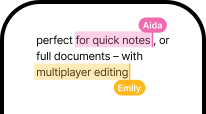
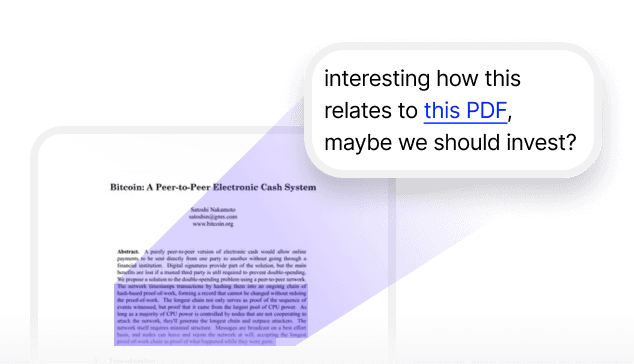
Highlight and comment directly on readings, PDFs, and ebooks. Your annotations are searchable across your library. Your AI tutor can reference your highlights when answering questions.
Reader
Read saved articles and ebooks in the reader for a clean, distraction-free experience with estimated read times. Your highlights and notes stay attached and are searchable.
Canvas
Map essay structure, arrange sources, and see the shape of an argument visually on the canvas. Pull in readings, notes, and lecture content as reference cards.
Quick capture
Record a voice note, photograph a whiteboard, save a link, or clip an article in seconds. Everything feeds the same library your AI tutor studies from. Every new source makes your tutor smarter about your course.
Templates for structured studying.
Start with a template designed for academic work: Cornell method lecture notes, SQ3R study notes, essay outline, dissertation chapter planner, literature review, or book notes. Browse the full template marketplace for more.
FAQ
How is this different from ChatGPT?
ChatGPT answers from its training data. Your Fabric AI tutor answers from your materials: your syllabus, your readings, your lecture transcripts, your notes. Every answer cites a specific page, slide, or timestamp from your course. It is a personal tutor that has read your stuff, not a general-purpose chatbot. See a detailed comparison.
How is this different from NotebookLM?
NotebookLM is per-project with up to 300 sources per notebook. Fabric is a persistent library across your entire degree. NotebookLM does not record lectures, annotate documents, or provide a study workspace. Fabric does all of these with an AI tutor that has memory across sessions. See Fabric vs NotebookLM.
How is this different from Khanmigo?
Khanmigo tutors from Khan Academy's curated curriculum and is designed primarily for K-12 students. Your Fabric AI tutor answers from your own uploaded materials, making it suited to university-level courses with specific readings and frameworks. See Fabric vs Khanmigo.
Can my AI tutor quiz me on my course material?
Yes. Ask your tutor to test you on a lecture, a reading, a module, or the full semester. It generates questions from your actual content, not from a generic question bank.
Does my AI tutor remember what I have studied?
Yes. Your tutor has memory across sessions. It remembers what you have asked, what you have struggled with, and what you have covered. It adapts to your learning over time rather than resetting every conversation.
Can I record and transcribe lectures?
Yes. AI voice notes record and transcribe any lecture with timestamps. Your typed notes and the transcript merge into one document. No meeting bot required. See the lecture notes workflow.
Can I search across all my course materials at once?
Yes. Smart search reads inside every PDF, slide deck, ebook, note, and transcript. One search bar for everything. The search works by meaning, not just keyword.
Can I annotate readings and have annotations be searchable?
Yes. Annotations let you highlight and comment on any PDF, article, or ebook. Your annotations are searchable across every reading in your library.
Can I use Fabric for my dissertation?
Yes. Manage your literature, write chapters, and search across your full research library with AI synthesis. See the dissertation and thesis use case and the dissertation workflow guide.
Can I collaborate with my study group?
Yes. Share a space and work together with real-time collaboration. Your AI tutor searches across everything the group has collected. See group projects.
Does the library get more useful over a degree?
Yes. Every lecture, reading, and note you add deepens what your AI tutor can draw on. A question asked in your final year draws from every course you have taken. The investment in capturing materials compounds across your degree into a personal knowledge base.
Are there templates for note-taking?
Yes. The template marketplace includes Cornell method, SQ3R, essay outline, dissertation planner, literature review, book notes, and more.
Is my coursework and notes private?
Yes. Your content is encrypted and only visible to you unless you choose to share a space. Fabric uses AES-256 encryption and is CASA Tier 2 compliant. Your data is never used to train AI models. See the privacy and security guide.
Does it work on my phone?
Yes. The mobile app lets you record voice notes, photograph whiteboards, type thoughts, and search your library. Everything syncs across devices.
Is Fabric free for students?
Fabric has a generous free plan. The Plus plan is $5/month for students who need more. See pricing for full details. Comparing tools? See why students choose Fabric as the best AI study app, the best AI note-taking app for students, and the best app for PhD students. See how Fabric compares to TurboLearn and StudyFetch.