Literature Review
A structured way to read critically, track your sources, and build your argument.
About
What is the Literature Review template?
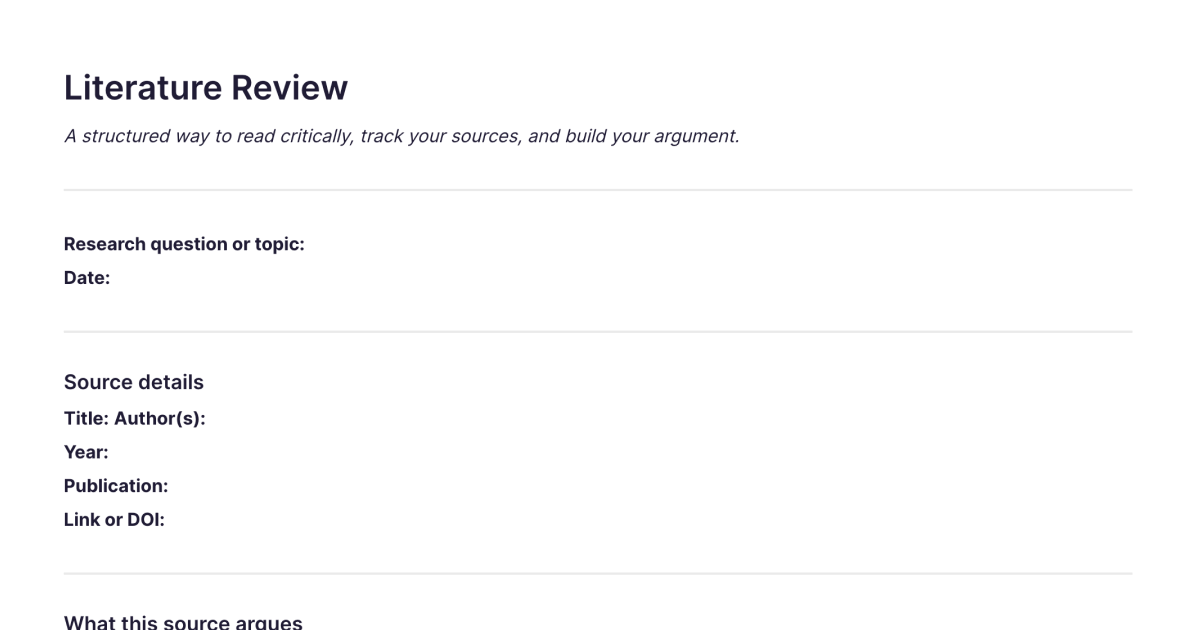
The Literature Review template is a structured note for reading one source critically. For each paper or book you take into your review, you capture what it argues, how it reached its conclusions, what it gets right and wrong, and, most importantly, how it connects to your research and to the other sources you've read. You add it to your workspace once and duplicate it for each source, building up a set of critical notes that becomes the raw material for the review itself.
The reason it's built around a single source is that a strong literature review is an argument about the state of knowledge, not a parade of summaries. The way you avoid the summary trap is by reading each source critically and relationally from the start, capturing not just what it says but how it relates to everything else. This template builds that habit into every source you read.
What's laid out for you
The template prompts for the things that make a source usable later rather than just read:
Source details and what it argues. The bibliographic details, and the core claim in your own words, so you've understood it rather than just filed it.
Methodology, findings, strengths, and limitations. How the authors reached their conclusions, the findings relevant to your question, and an honest read of what the source does well and where it's weak. Capturing limitations is what lets you evaluate a source rather than just describe it.
How it connects to your research, and to other sources. The two most important prompts. Whether a source supports, challenges, or complicates your argument, and whether it agrees with, disagrees with, or fills a gap left by other things you've read. These connections are the substance of a literature review, and noting them as you read is what makes synthesis possible later.
Quotations and a verdict. A line or two worth citing, with page numbers, and a one-sentence call on whether the source is essential, useful, or peripheral to your argument.
Filling these in for each source takes a few minutes after reading and saves the far larger effort of trying to reconstruct it months later under deadline.
How it works in Fabric
A literature review can run to a hundred sources or more, which is exactly where keeping these notes in Fabric pays off. Every source note is searchable by meaning, so you can find the paper that made a particular argument by describing it, not by remembering its author. You can annotate the source PDF and tie your highlights to its note, keeping the evidence connected to your reading of it.
The synthesis stage, the hardest part of any review, is where the AI assistant helps most: ask it what you've gathered on a particular debate, or which of your sources address a given theme, and it draws across all your notes at once. Because every source note already records how it connects to others, the threads are there to follow rather than reconstruct. Your sources, notes, and drafts all live in one library, so the review is built on top of a connected body of reading rather than a folder of disconnected PDFs.
How to use it
Add it once. Install the template from the store and it's in your workspace.
Duplicate it per source. Make a copy for each paper or book you read, named for the source.
Read critically, not just for content. Capture the argument, methodology, and limitations, and above all how the source connects to your research and to your other reading.
Synthesise across your notes. Once you have notes from enough sources to see patterns, group them by theme rather than by source, and let search and the assistant help you pull the threads together.
Learn the method
This template handles the per-source reading; for how to plan, search, synthesise, and write the review itself, the literature review guide is the complete walkthrough, including how to organise by theme and turn your sources into an argument. The research workflow guide covers the capture-read-synthesise habit underneath it, and if your review is part of a larger project, the dissertation workflow guide covers the whole. To plan the review as a chapter alongside the rest of your dissertation, the Dissertation Chapter Planner template pairs naturally with these source notes. If you're processing a paper for its own sake rather than for a review's argument, the Research Paper Summary template is the lighter, general-purpose companion. And when you turn your reading into a written argument, the Essay Outline template is where you structure it.
Frequently asked questions
What is the Literature Review template?
It's a free Fabric note for reading one source critically, with prompts for its argument, methodology, findings, strengths, limitations, connections to your research and to other sources, quotations, and a verdict. You add it once and duplicate it for each source in your review.
Is it one note per source or per review?
Per source. You duplicate it for each paper or book, building up a set of critical notes. The review itself is then written by synthesising across those notes, grouping them by theme rather than by source.
How do I use it?
For each source, fill in what it argues, how it reached its conclusions, its strengths and limitations, and how it connects to your research and your other reading. Each copy is a normal Fabric note, so it's searchable and can link to the source PDF.
Is it free?
Yes. The Literature Review template is free to add and use.
How does this help me avoid just summarising sources?
By prompting, for every source, how it connects to your argument and to other sources, not only what it says. Those connection prompts are the difference between a summary and a synthesis, and they're the part most literature reviews get wrong. The literature review guide explains the distinction in depth.
Can the AI help me synthesise my sources?
Yes. The AI assistant can draw across all your source notes, telling you what you've gathered on a theme or which sources speak to a particular debate, which is where the synthesis work is hardest.
Can I keep the source PDFs with my notes?
Yes. Your source notes live in the same library as the PDFs, and you can annotate a PDF and connect your highlights to its note, all searchable by meaning.
Does it work for a standalone review or only a dissertation?
Both. The per-source critical reading approach suits any literature review, whether it's a standalone piece, a journal article's review section, or the literature review chapter of a dissertation or thesis.
Can I use it on my phone?
Yes. With the mobile app you can capture notes on a source wherever you read it, and they sync across your devices.
Where can I learn to write the review itself?
The literature review guide is a complete walkthrough of searching systematically, organising by theme, identifying the gap, and writing a review that argues rather than summarises.
What is Fabric?
Fabric is an AI workspace for your projects, ideas, and files.
Save anything – PDFs, images, links, notes, voice memos, videos – and search across all of it by meaning, not just keywords. Think visually on an infinite canvas, connect your tools like Gmail, Google Drive, Notion, and Figma, and work alongside a personal AI assistant that knows your work, remembers your context, and gets smarter the more you use it.
Available on web, iOS, Android, and desktop.
