Made for startups
Documentation that grows with your company
You're growing too fast to maintain documentation and too busy to have someone whose job it is.
Self-writing docs solve both problems.
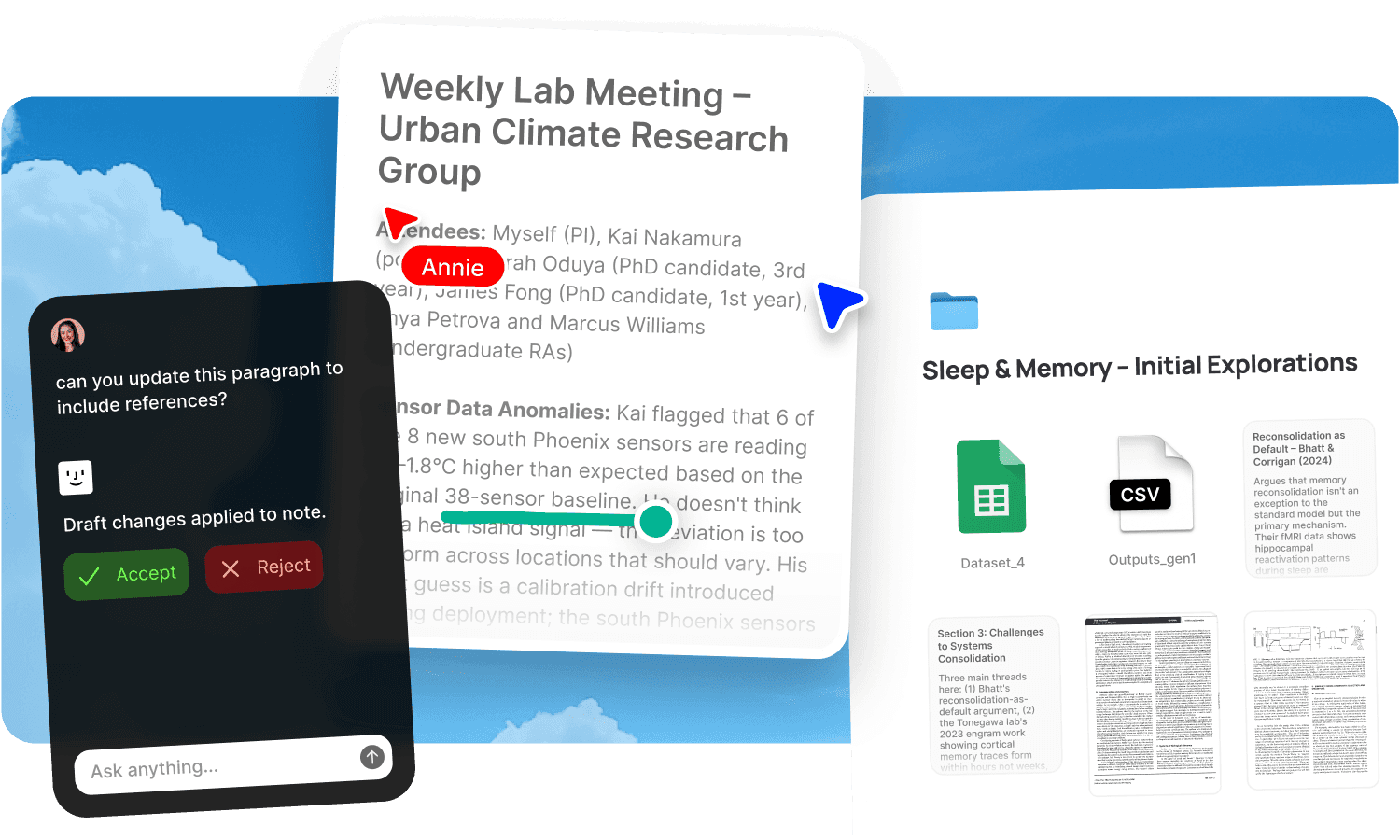
You're growing too fast to maintain documentation and too small to have someone whose job it is. The engineering decisions live in Slack threads that scroll away. The product rationale lives in the founder's head. The onboarding process lives in a Google Doc from eight months ago that nobody has updated because everyone who could update it is shipping. Every week you hire someone new who needs context, and every week the context gets harder to find because the company is moving faster than anyone can document.
Fabric connects to your Slack, meetings, and GitHub, and self-writing docs produce documentation that grows with your company without anyone stopping to write anything.
Self-writing docs that compound from day one
Self-writing docs connect to what your team is already doing and produce the documentation you need but can't prioritise:
Engineering docs covering architecture decisions, API documentation, and system overviews, assembled from PRs, Slack, and technical discussions. No wiki maintenance competing with shipping.
Decision logs capturing what was decided, when, and why, from the meetings and Slack threads where startup decisions actually happen. When the new hire asks "why do we do it this way," the answer exists.
Onboarding guides that stay current as processes change. The guide reflects what's true today, not what was true when someone last had time to update it.
A company changelog tracking launches, changes, and milestones. Assembled from your activity, not from someone remembering to write a release note.
It compounds: after a month you have a documentation set that would have taken weeks of manual authoring. After six months, a comprehensive knowledge base reflecting your full history. It got there without anyone being assigned to write it.
AI search that always has the answer
AI search means the answer to "how does our pricing work" or "why did we drop that feature" is always findable, even if it was only ever said in a standup. The search works by meaning across everything: Slack, meeting transcripts, documents, emails, and GitHub activity.
The AI assistant synthesises across sources. Ask it to explain the rationale behind a product decision, trace the history of a feature from first discussion to launch, or pull together what the team has said about a specific customer segment. It cites every source.
New hires stop asking the same questions that interrupt everyone. They search, they get cited answers, and they're productive faster.
Agents that handle the coordination tax
The coordination overhead that's manageable at five people becomes crushing at twenty. Agents handle the operational glue that multiplies as you grow:
One reads standup notes and moves the relevant tickets in your project tracker.
Another drafts the Monday update from last week's activity and posts it to the team channel. No more Sunday evening scramble to write the weekly summary.
Another watches your hiring pipeline and keeps the onboarding docs current as processes change, so every new hire gets accurate information regardless of how fast things are moving.
The coordination tax that used to require a person now runs in the background.
Every new hire starts with full context
At a startup, institutional memory is fragile. When the third engineer joins, the first two have context the third doesn't. When the tenth person joins, the gap is wider. Self-writing docs and AI search mean every new hire inherits the company's full searchable history from day one.
They ask the AI assistant "how does auth work" and get a cited answer from the engineering docs, Slack discussions, and the PR where it was implemented. They ask "who's our target customer" and get the answer from the strategy discussion, the pitch deck, and the founder's notes. No ramp-up week of interrupting everyone with questions that have been answered before.
For structuring the onboarding experience, see onboarding new team members and the guide to onboarding collaborators.
Tracked sharing for investors and partners
Publish pitch decks, data rooms, and investor updates with password protection and link analytics. See who's opened the deck, how long they spent, and whether they've shared it. Create individually named tracking links per investor.
For the full fundraising workflow, see data rooms and sales collateral.
Who at the startup uses Fabric
Founders maintain strategic context and investor relationships. Developers get self-writing engineering docs. Product managers track decisions and project documentation. Designers manage assets and design projects. Sales professionals share materials with tracked links. Indie hackers building solo use self-writing docs for when the team arrives.
For the team wiki approach, see team wiki. For lightweight pipeline management, see CRM.
Get started
Give your startup documentation that grows with the company, without anyone stopping to write it. Try Fabric free. See pricing for teams.
FAQs
How do self-writing docs work?
Self-writing docs connect to your Slack, meetings, and GitHub. They assemble documentation from your team's actual conversations and activity: engineering docs, decision logs, onboarding guides, and changelogs. Docs appear within 24 hours and update continuously.
Can anyone search across Slack, meetings, and docs at once?
Yes. AI search connects to your tools and searches across everything by meaning. Answers are cited with links to the exact source.
Can agents post the Monday update automatically?
Yes. Agents assemble the weekly update from last week's activity and post it to the team channel.
Can agents move tickets from standup notes?
Yes. An agent reads the standup notes and moves the relevant tickets in your project tracker.
Do the onboarding docs stay current as we change?
Yes. Onboarding docs update from your team's activity. The guide reflects the current state of your company, not a snapshot from when it was last manually updated.
Can new hires search the company's full history?
Yes. Every decision, discussion, and document is searchable from day one. New hires ask questions and get cited answers without interrupting colleagues.
Does the documentation compound over time?
Yes. After a month, you have documentation that would have taken weeks to write manually. After six months, a comprehensive knowledge base reflecting your full history. It builds without anyone being assigned to maintain it.
Can we track investor engagement with our deck?
Yes. Publish with link analytics and create named tracking links per investor. See who's opened the deck and how long they spent.
What tools does Fabric connect to?
Fabric connects to Slack, GitHub, Linear, Google Drive, Dropbox, Notion, Gmail, and meeting tools. See connections for the full list.
Is our data secure?
Yes. Fabric uses AES-256 encryption and is CASA Tier 2 compliant. Your data is never used to train AI models.
How is this different from Notion or Confluence?
Notion and Confluence require someone to write and maintain documentation. At a startup, nobody has time, so the docs rot or never get written. Fabric's self-writing docs produce themselves from your Slack, meetings, and GitHub activity. The documentation exists because it's assembled from what your team is already doing, not from a separate writing task nobody can prioritise.