SQ3R Study Notes
Survey, Question, Read, Recite, and Review. A research-backed method for reading and retaining complex material. Work through each stage in order.
About
What is the SQ3R Study Notes template?
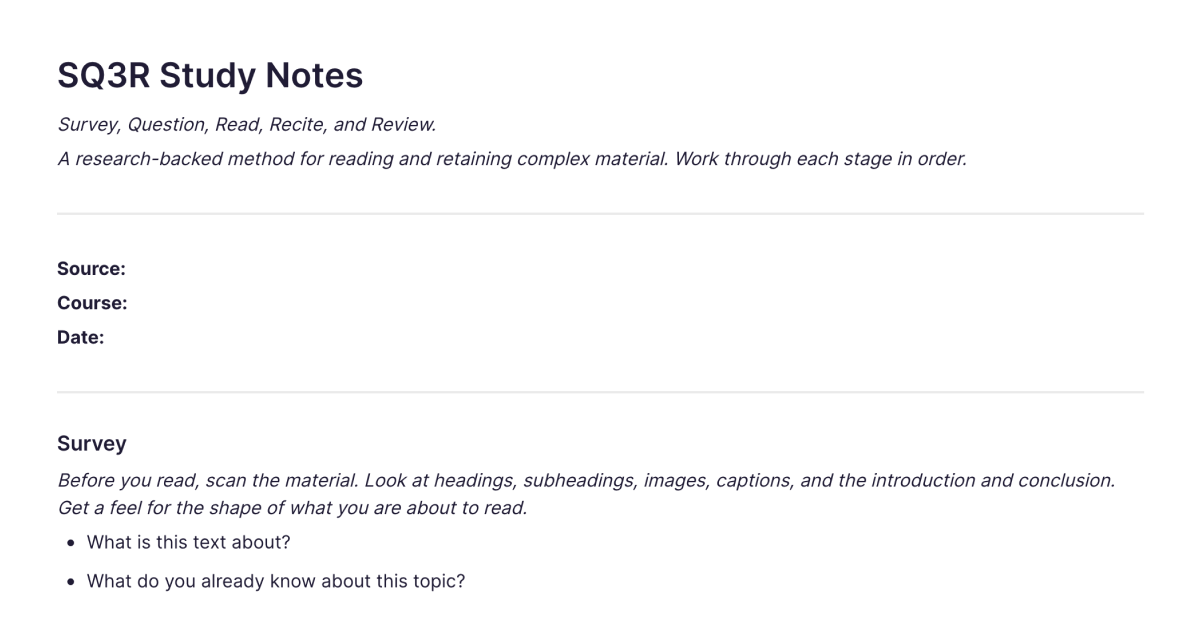
The SQ3R Study Notes template is a ready-made note for studying with the SQ3R method, a research-backed approach to reading and retaining demanding material. SQ3R stands for its five stages: Survey, Question, Read, Recite, and Review. The template lays out a section for each stage, in order, so instead of staring at a blank page and a dense chapter, you have a structure that walks you through reading actively rather than passively. You add it to your workspace once and duplicate it for each reading or chapter you work through.
What is the SQ3R method?
SQ3R was developed in the 1940s and has been taught ever since because it addresses a real problem: reading something once, start to finish, is a poor way to understand or remember it. The method replaces a single passive read with five deliberate stages.
Survey. Before reading properly, skim the whole thing, headings, summaries, diagrams, the first and last paragraphs. You're building a map of the territory so that when you read in detail, you know where each part fits.
Question. Turn the headings and the survey into questions you want the text to answer. "What causes this?" "How does this differ from that?" Reading to answer your own questions is far more active than reading to get to the end.
Read. Now read properly, looking for the answers to the questions you raised. Because you're reading with a purpose, you engage with the material rather than letting your eyes pass over it.
Recite. After a section, look away and say or write the answer in your own words. This is retrieval practice, recalling something from memory rather than re-reading it, which is one of the most effective learning techniques there is.
Review. Come back to the material at intervals and test yourself from your questions and notes. Spaced review holds far more in long-term memory than a single cram session.
What the template gives you
A section for each of the five stages, already laid out and labelled, so the method is built into the page rather than something you have to set up. You fill in each section as you go: your survey impressions, the questions you raised, your notes from reading, what you could recite from memory, and your review passes. Working top to bottom takes you through SQ3R in the order it's meant to be done.
Because each filled-in note is a Fabric note, your study notes don't disappear after the exam. They're searchable by meaning across everything you've studied, so months later you can find what a chapter covered by describing it. You can ask the AI assistant to test you from your questions, summarise what you noted across several readings, or pull together everything you've studied on a topic. And you can study in more than text: add a voice note reciting a section aloud, or a photo of a diagram, in the same note.
How to use it
Add it once. Install the template from the store and it's in your workspace.
Duplicate it per reading. Make a copy for each chapter, paper, or reading you're working through.
Work the sections in order. Survey first, then write your questions, then read, then recite from memory, then review. The template keeps you moving through the stages rather than collapsing back into a single passive read.
Come back and test yourself. Use your questions and recite notes for spaced review later, and let Fabric's search bring any note back when you need it.
Related study methods and guides
SQ3R is one of several structured approaches to studying and note-taking. The Cornell method is a closely related note-taking format built around the same principles of questioning, retrieval, and spaced review, and pairs well with SQ3R for lectures and reading, its Lecture Notes (Cornell Method) template is the ready-made companion for capturing classes. For the bigger picture of how reading, notes, and review fit together, see building a student study system and note-taking basics.
Frequently asked questions
What does SQ3R stand for?
Survey, Question, Read, Recite, Review, the five stages of the method. You skim first, turn what you find into questions, read to answer them, recall in your own words, then review at intervals.
What is the SQ3R Study Notes template?
It's a free Fabric note with a section for each SQ3R stage, laid out in order. You add it once and duplicate it for each reading, then work through the stages from the top of the note down.
How do I use it?
Duplicate the template for a chapter or reading, then fill in each stage's section as you go, surveying, raising questions, reading, reciting from memory, and reviewing. Each copy is a normal Fabric note, so it's searchable and can hold text, voice, and images.
Is it free?
Yes. The SQ3R Study Notes template is free to add and use.
Is SQ3R actually effective?
The method is built on principles that learning research consistently supports: active reading, generating your own questions, retrieval practice, and spaced review. Reciting from memory and reviewing at intervals, in particular, retain far more than re-reading. The Cornell method guide covers the same underlying research in more depth.
How is SQ3R different from the Cornell method?
SQ3R is a reading-and-study process with five stages; the Cornell method is a page layout for taking and reviewing notes. They overlap and work well together: SQ3R structures how you read, Cornell structures how you record and test yourself. Both rely on questioning and retrieval practice.
Can I find my study notes again later?
Yes. Each note is searchable by meaning across your whole library, so you can find what a reading covered by describing it rather than remembering when you studied it. Notes stay searchable indefinitely.
Can the AI assistant quiz me from my notes?
Yes. The AI assistant can test you using the questions and recite sections in your notes, summarise across several readings, or gather everything you've studied on a topic.
Can I use it on my phone?
Yes. With the mobile app you can study, recite into a voice note, or photograph a page on the go, and your notes sync across devices.
Who is SQ3R best for?
Anyone reading to understand and retain demanding material: students working through textbooks and papers, and anyone studying dense nonfiction. It's most useful when a single read-through isn't enough and you need the material to stick.
What is Fabric?
Fabric is an AI workspace for your projects, ideas, and files.
Save anything – PDFs, images, links, notes, voice memos, videos – and search across all of it by meaning, not just keywords. Think visually on an infinite canvas, connect your tools like Gmail, Google Drive, Notion, and Figma, and work alongside a personal AI assistant that knows your work, remembers your context, and gets smarter the more you use it.
Available on web, iOS, Android, and desktop.
