Built for physics students
Fabric for physics students
Problem sets, derivations, lab data, lecture notes. AI tutor that walks through a derivation using your professor's specific approach rather than a generic textbook method.
Problem sets, derivations, lab data, lecture notes, simulation outputs, textbook chapters, past papers. Physics students work through dense mathematical content where the professor's specific approach to a derivation matters more than the textbook's version, because the exam tests what was taught in the lecture, not what's in Griffiths. When you're stuck on a problem set at midnight and need to revisit how the lecturer derived the wave equation, scrolling through slides isn't fast enough. When you're writing a lab report and need to connect your experimental data to the theoretical prediction, the theory and the data are in different places.
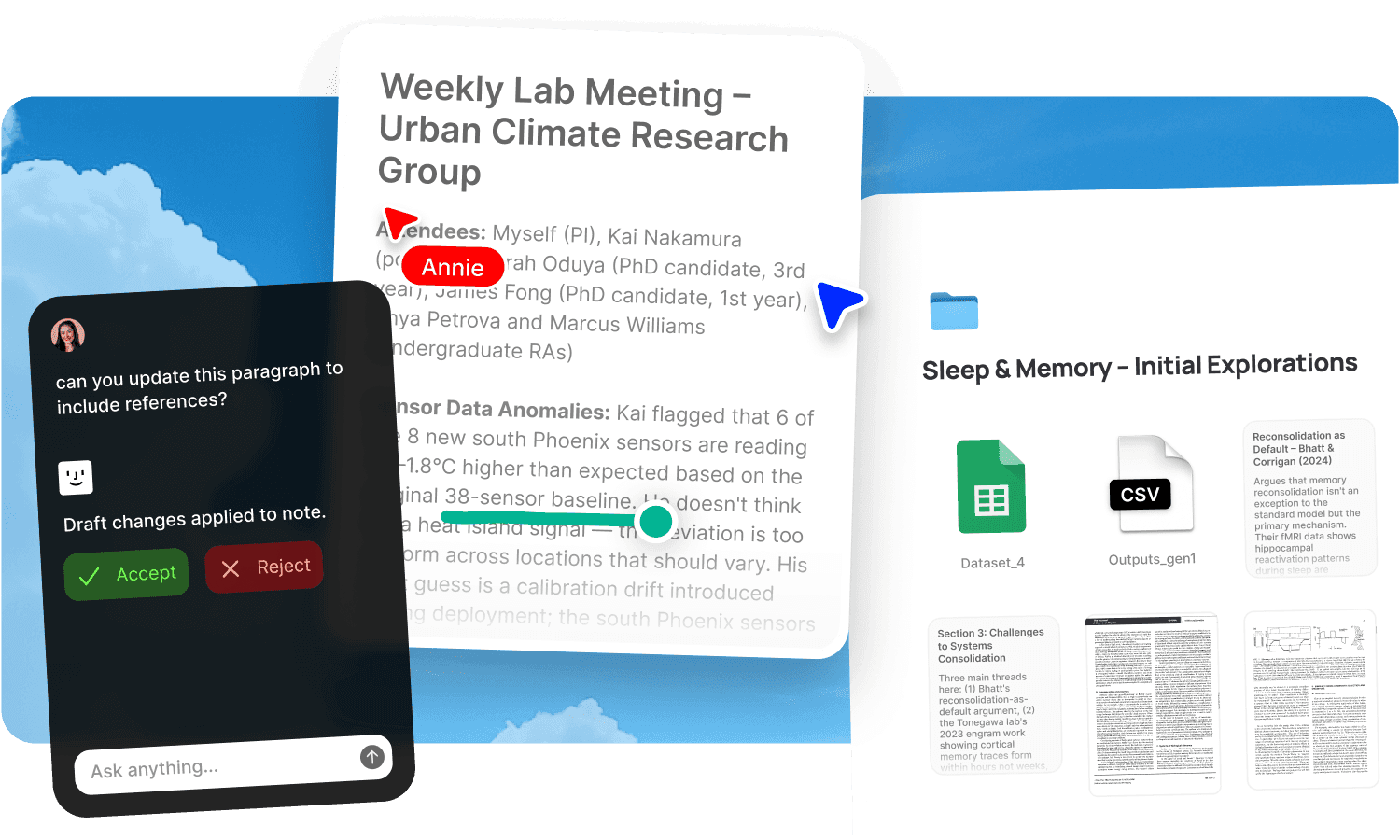
Upload your materials to Fabric. The AI assistant walks through a derivation using your professor's specific approach rather than a generic textbook method. "Show me how we derived the Schrodinger equation in the quantum mechanics module." "Find every problem we covered involving Lagrangian mechanics." "Explain why my experimental results differ from the theoretical prediction." Answers from your course.
An AI tutor that follows your professor's approach
The AI assistant works from your lecture slides, problem sets, lab data, textbook chapters, and notes. Ask it to walk through a derivation the way your lecturer did it. Ask it to explain where your calculation diverged from the expected result. Ask it to connect the theory from a lecture to the data from a lab. Ask it to find the relevant formula from a specific module.
The assistant follows your course's notation and conventions rather than substituting a generic textbook approach. It has memory across sessions, so it builds on what you've previously worked through.
Search across every module by concept
AI search finds material by physical concept: "every problem involving integration by parts" or "the lecture about rotational dynamics" or "Maxwell's equations in the electromagnetism module" across your full library. The search connects across years, so the mathematical technique from first year is findable when you need it for a final-year problem.
Record lectures and tutorials
AI voice notes record and transcribe lectures, tutorials, and problem classes. The lecturer's derivation, the tutor's explanation of where the class went wrong, the demonstrator's lab briefing, all captured and searchable. Your typed notes and the transcript merge into one document. See lecture notes.
Annotate problem sets and derivations
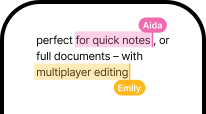
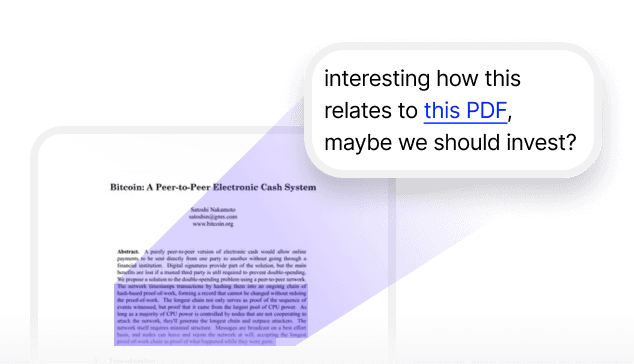
Annotations let you mark up problem sets, derivations, and textbook chapters with searchable notes. Flag the step where you got stuck. Note the physical insight behind a mathematical step. Mark the approximation that simplifies the problem.
Write lab reports alongside your data
Draft lab reports in notes and docs with your experimental data and theoretical content searchable alongside. When you need to reference the derivation, find the relevant constant, or cite the theory, search without leaving the draft.
Get started
Upload your materials and get a tutor that knows your professor's approach. Try Fabric free.
See also: Fabric for students. Studying and exam prep. Lecture notes.
Comparing tools? See the best AI study app.
FAQs
Can the AI use my professor's derivation approach?
Yes. The AI assistant works from your uploaded lecture materials and follows the notation and methods used in your course.
Can I search for problems by concept?
Yes. AI search finds problems, derivations, and notes by meaning. "Problems involving angular momentum" finds them across your full library.
Can I connect theory to lab data?
Yes. The assistant works from your theoretical and experimental materials together and can help explain discrepancies between predictions and results.
Can I record lectures?
Yes. AI voice notes record and transcribe any lecture with timestamps.
Can I connect techniques across years?
Yes. Search works across every module and year. A first-year mathematical technique is findable when it's relevant to a final-year problem.
Can the AI quiz me?
Yes. Ask it to test you on any topic from your programme materials.
Does it remember what I've worked through?
Yes. The assistant has memory across sessions and builds on previous conversations.
Is my data private?
Yes. Fabric uses AES-256 encryption and is CASA Tier 2 compliant. Your data is never used to train AI models.