Built for mathematics students
Fabric for mathematics students
Problem sets, proofs, lecture notes. Fabric searches across your notes by concept, not just keyword. AI tutor that follows your course's notation and conventions.
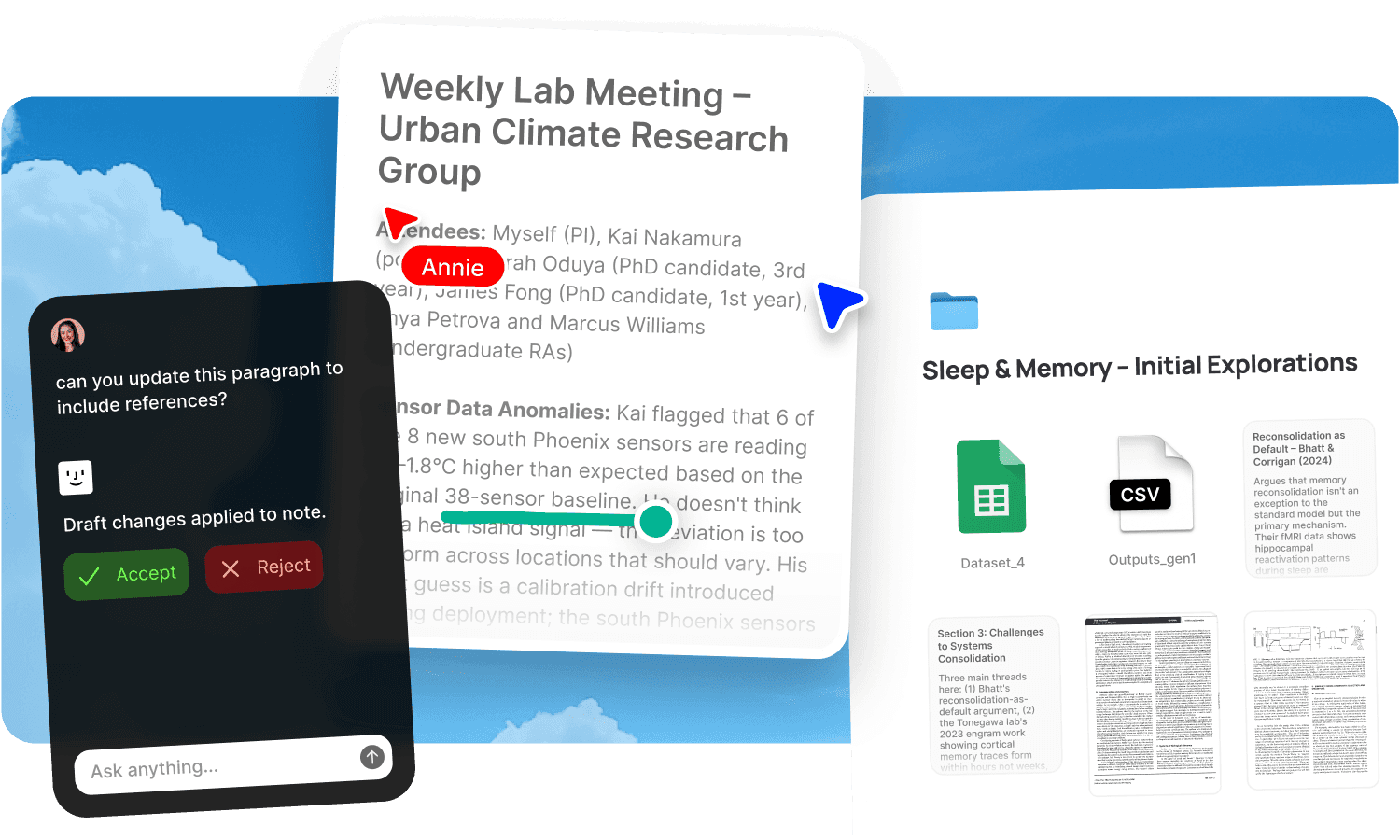
Problem sets, proofs, lecture notes, tutorial exercises, textbook chapters, past papers. Mathematics is cumulative in a way that makes retrieval critical: a technique from a first-year analysis course is needed for a third-year differential equations problem, but finding the original notes means remembering which module, which week, and which notebook. The notation your course uses matters, and a generic explanation that uses different conventions can confuse more than it clarifies. The proof the lecturer built in one specific way is the proof you need for the exam, not the textbook's alternative approach.
Upload your materials to Fabric. The AI assistant searches by concept, follows your course's notation, and helps you trace techniques across modules. "Find every problem we covered involving integration by parts." "Explain the proof from last week's real analysis lecture." "Show me how we defined continuity in the analysis module." Answers from your course.
An AI tutor that follows your notation
The AI assistant works from your lecture notes, problem sets, proofs, and textbook chapters. It follows the notation and conventions used in your course rather than substituting a generic textbook approach. Ask it to walk through a proof from your lectures. Ask it to connect a technique from one module to a problem in another. Ask it to explain a definition using the context your lecturer provided.
The assistant has memory across sessions. It knows which modules you've covered, which techniques you've practised, and can build on previous conversations about specific topics.
Search by mathematical concept
AI search finds material by mathematical concept across your full library. "The epsilon-delta definition of continuity" or "every exercise involving eigenvalues" or "the proof about compactness from the topology module" finds the relevant notes and problems by meaning. The search connects across years, so a first-year technique is findable when a final-year course requires it.
Record lectures and tutorials
AI voice notes record and transcribe lectures and tutorials. The lecturer's construction of a proof, the tutor's walkthrough of a tricky problem, the discussion in a tutorial, all captured and searchable. Your typed notes and the transcript merge into one document. See lecture notes.
Annotate proofs and problem sets
Annotations let you mark up problem sets, proofs, and textbook chapters with searchable notes. Flag the key step in a proof. Note the trick that makes a problem tractable. Mark the theorem you keep needing to reference.
Write alongside your work
Draft coursework and essays in notes and docs with your full library searchable alongside. The canvas helps you map the structure of a proof or the relationships between topics visually.
Get started
Upload your notes and get a tutor that speaks your course's mathematical language. Try Fabric free.
See also: Fabric for students. Studying and exam prep. Dissertation and thesis.
Comparing tools? See the best AI study app.
FAQs
Does the AI follow my course's notation?
Yes. The AI assistant works from your uploaded materials and uses the notation and conventions from your course.
Can I search proofs by concept?
Yes. AI search finds proofs, techniques, and exercises by mathematical concept across your full library.
Can I connect techniques across modules and years?
Yes. Search works across every module. A first-year technique is findable when it's relevant to a third-year problem.
Can I record lectures?
Yes. AI voice notes record and transcribe any lecture with timestamps.
Can I annotate proofs with notes?
Yes. Annotations let you mark up any document with searchable notes.
Can the AI quiz me?
Yes. Ask it to test you on definitions, theorems, or problem types from your actual materials.
Does it remember what I've studied?
Yes. The assistant has memory across sessions and builds on your mathematical development.
Is my data private?
Yes. Fabric uses AES-256 encryption and is CASA Tier 2 compliant. Your data is never used to train AI models.