Made for marketing teams
Your marketing team's knowledge, always on
Campaign briefs, brand guidelines, competitive research, and meeting notes, all searchable with cited answers.
Docs that write themselves. Agents that act.
Marketing produces and consumes enormous volumes of content: campaign briefs, brand guidelines, competitive research, analytics reports, meeting notes from cross-functional reviews. None of it lives in the same place. The strategy doc is in Google Drive, the decision was made in Slack, the competitive intel is in someone's email, and the campaign results are in a dashboard nobody bookmarks. When someone asks "what was our messaging for the enterprise segment last quarter," the answer exists across five tools and takes thirty minutes to reconstruct. Every quarter this gets worse because the volume grows and the team's memory doesn't.
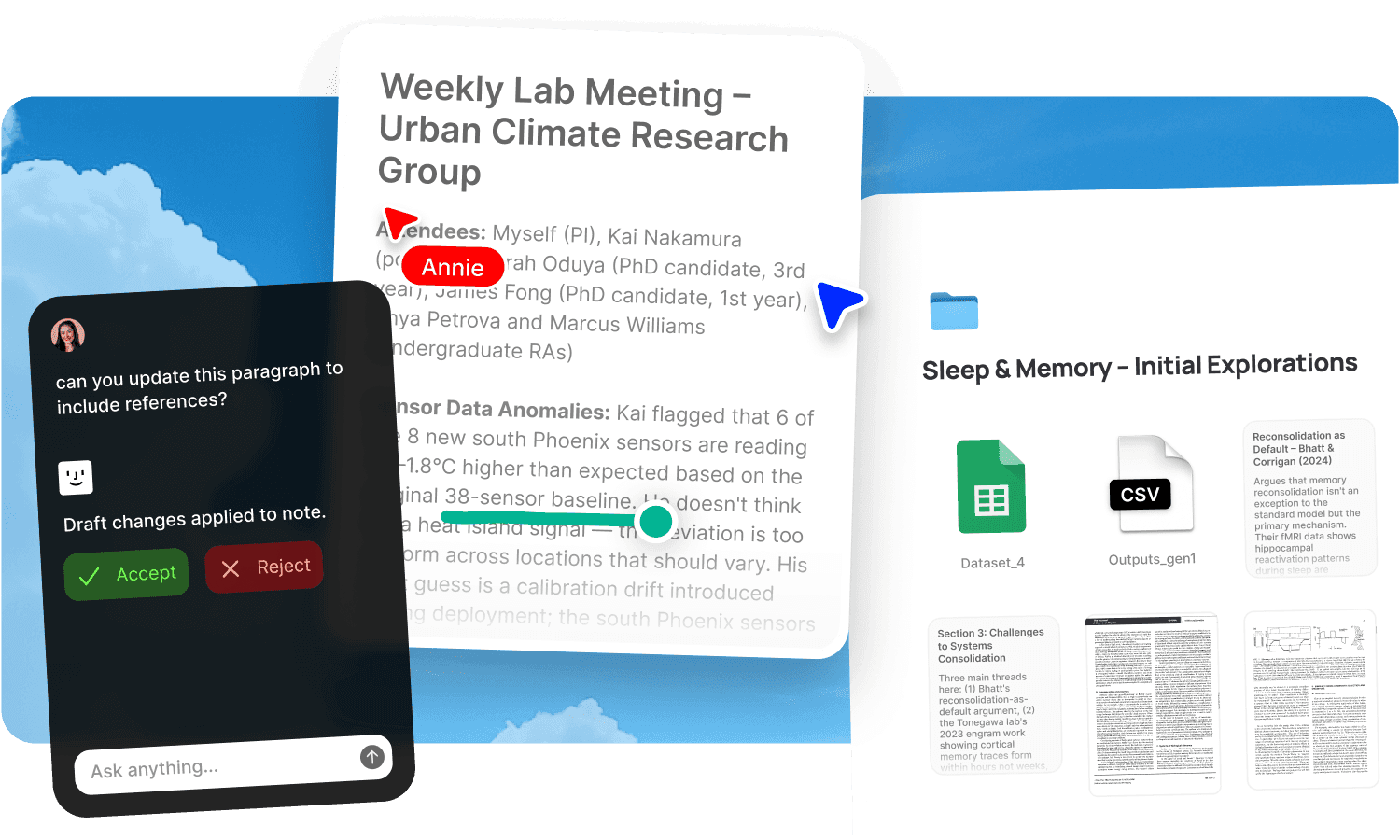
Fabric connects to your communication tools, file storage, and project management, and makes everything searchable in one place. Self-writing docs produce the records your team actually needs. Agents handle coordination and first drafts so the strategic thinking stays human.
AI search with cited answers across everything
AI search lets anyone on the team ask "what was our messaging for the enterprise segment last quarter" or "competitive positioning against [competitor]" and get cited answers drawn from strategy docs, meeting transcripts, and Slack threads, linked to the exact source. No more digging through drives, channels, and inboxes to reconstruct what was already discussed.
The search works across every connected tool and every content type: documents, PDFs, images, recordings, emails, and messages. It searches by meaning, not keyword, so you find answers even when the phrasing in the source doesn't match the question.
The AI assistant synthesises across sources. Ask it to pull together the competitive landscape from the past quarter's research, or summarise what was decided in the last three campaign review meetings. It cites every source it draws from.
Self-writing docs that stay current
Self-writing docs connect to your Slack, meetings, and workspace activity, and produce living documentation that updates as your team works:
A decision log capturing campaign approvals, strategy pivots, and positioning changes as they happen in meetings and channels. No manual logging.
A company changelog tracking launches, updates, and announcements so the team always knows what shipped and when.
A sales knowledge base keeping messaging, positioning, and battlecards current as the market shifts, assembled from your actual conversations and strategy docs.
The docs appear within 24 hours and update continuously. They reflect what your team is actually saying and deciding, not what someone remembered to write down last month.
Agents that draft, coordinate, and act
Agents go beyond retrieval. They take action on your behalf:
One monitors your analytics dashboards and drafts the weekly performance summary, ready for review and distribution.
Another reads the campaign brief, pulls relevant past campaigns and brand guidelines, and drafts the first pass of copy in your brand voice.
Another takes the approved launch plan and creates the tasks across your project tracker, assigns owners, and posts the timeline to the team channel.
The strategic thinking stays human. The coordination and first drafts don't have to.
Visual search for brand assets
Marketing teams work with visual content constantly. AI search finds visual assets by colour, composition, and subject, not just filename. Search "forest green" or use a colour picker to find every asset in a specific palette. Similar search finds visually related creative across your library. For managing the full brand asset library, see digital asset management.
Tracked sharing for every deliverable
Publish campaign materials, reports, and deliverables with password protection and link analytics. See who's opened the deliverable, how long they spent, and which sections they viewed. Create individually named tracking links per stakeholder.
Who on the team uses Fabric
Marketers search across campaigns and track competitive research. Content creators plan and draft with content planning workflows. Designers manage visual assets and build moodboards. Product managers share positioning and roadmap context. Sales professionals access the self-writing sales knowledge base for current messaging and battlecards.
Get started
Give your marketing team one searchable workspace where every brief, strategy, and decision is findable with cited answers. Try Fabric free. See pricing for teams.
FAQs
Can anyone on the team search across Slack, docs, and meetings at once?
Yes. AI search connects to your tools and searches across everything by meaning. Answers are cited with links to the exact source.
What are self-writing docs?
Self-writing docs connect to your team's Slack, meetings, and workspace, and automatically produce and update documentation: decision logs, changelogs, knowledge bases. They write themselves from your actual conversations and activity.
Can agents draft campaign copy?
Yes. Agents can read a brief, pull relevant past campaigns and brand guidelines, and draft the first pass in your brand voice. The strategic direction stays yours. The first draft doesn't have to be.
Can agents create tasks from a launch plan?
Yes. An agent can read the approved plan, create tasks in your project tracker, assign owners, and post the timeline to the team channel.
Can I search for assets by colour?
Yes. Search by colour name, hex code, or description. Similar search finds visually related assets across your library.
Can I share campaign materials with tracking?
Yes. Publish with password protection and link analytics. See who's viewed the material and how long they spent.
Does the decision log update automatically?
Yes. The decision log assembles from your meetings and Slack channels. When a campaign is approved or a strategy pivots, the log captures it without anyone manually writing it up.
Can new team members find past campaign context?
Yes. AI search makes the full history of your campaigns, decisions, and strategy searchable from day one. New hires ramp faster because the knowledge base is already built.
What tools does Fabric connect to?
Fabric connects to Slack, Google Drive, Dropbox, Notion, Gmail, GitHub, and meeting tools. See connections for the full list.
Is our data secure?
Yes. Fabric uses AES-256 encryption and is CASA Tier 2 compliant. Your team's data is never used to train AI models.
How is this different from just using Notion or Confluence?
Notion and Confluence hold pages someone has to write and maintain. Fabric's self-writing docs produce themselves from your Slack, meetings, and activity. AI search works across connected tools, not just pages in the wiki. Agents take action, not just answer questions. The documentation stays current because it's assembled from what your team is already doing.