Made for investment teams
Deal context that compounds across your portfolio
Deal flow, portfolio updates, market research, IC memos. The signal is buried in noise.
Fabric finds it, documents it, and acts on it.
Deal flow, portfolio updates, market research, IC memos, founder meeting notes, market maps, comparable analyses. The signal is buried in noise. The memo from the deal you passed on six months ago contained market sizing that's relevant to the deal you're evaluating today, but nobody will find it because it's in a folder named after a company you decided not to invest in. The IC discussion that shaped your thesis on climate tech was a meeting, not a document, and the reasoning was never written down. Every deal generates context that should compound into portfolio intelligence, and instead it decays into scattered files that nobody searches.
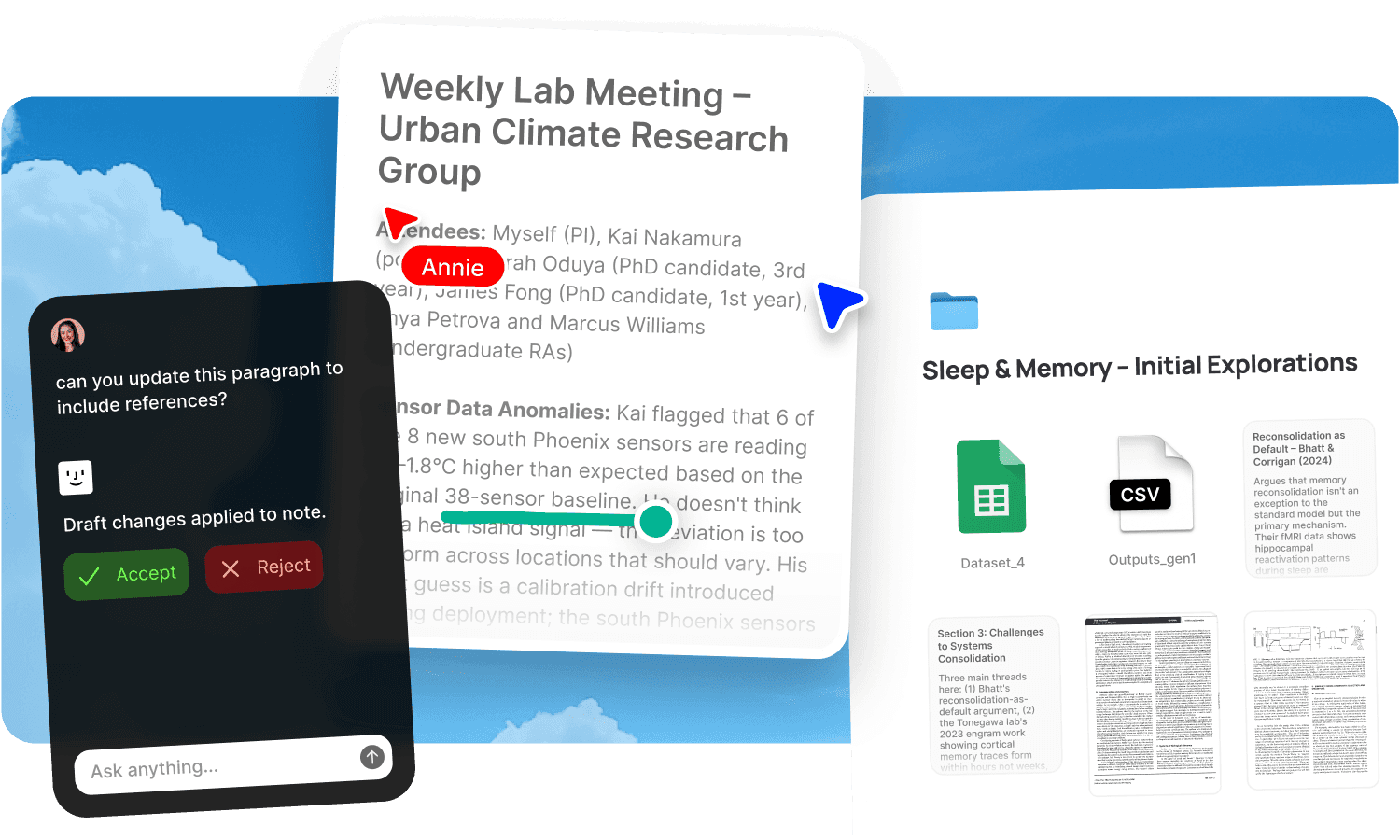
Fabric connects to your data sources and makes the full history of your investment activity searchable. Self-writing docs maintain deal files and IC records automatically. Agents monitor, draft, and coordinate so the team focuses on decisions, not administration.
AI search across the full portfolio
AI search lets anyone ask "what's our exposure to climate tech in Southeast Asia" and get cited answers drawn from memos, meeting notes, and market research across the entire portfolio, linked to the exact source. Ask "comparable deals in B2B payments with ARR above 10M" and find them across every memo and deal file you've ever produced.
The search works by meaning across every content type: IC memos, founder meeting transcripts, market research PDFs, email correspondence, and Slack threads. The AI assistant synthesises across sources: "summarise our thesis on vertical SaaS from the last twelve months of IC discussions" draws from every relevant meeting and memo.
The deal you passed on contributes to the knowledge base the same way the deal you made does. Nothing is wasted.
Self-writing deal files and IC records
Self-writing docs connect to your meetings and Slack and produce the records your team needs:
Client relationship trackers functioning as deal files: founder meeting summaries, deal context, key metrics, open items, and correspondence history, maintained automatically from calls and channels. Full context before every founder conversation without anyone updating a CRM.
Decision logs capturing IC discussions: what was decided, what the concerns were, what the vote was, and why. The reasoning survives alongside the outcome.
A changelog tracking what changed across the portfolio each week: new deals, follow-on activity, exits, and material developments.
The records reflect what was actually discussed and decided. Not what someone reconstructed for the Monday meeting.
Agents that monitor, draft, and brief
Agents act on the team's behalf:
One monitors news sources and flags material developments about portfolio companies directly in Slack. A regulatory change, a competitor launch, a key hire, surfaced to the team without anyone manually scanning headlines.
Another reads your founder meeting transcript, updates the deal file, and drafts the follow-up email, ready for review.
Another pulls together the weekly IC brief from all deal activity: new meetings, updated deal files, market research, and portfolio news, assembled into one document.
When it's time to write the investment memo, an agent drafts from your research, meeting transcripts, and comparable deals. The first pass is grounded in the team's actual work. The partner edits rather than writing from scratch.
Data rooms with tracking
Publish any document or collection with password protection and link analytics. Track who's opened the data room and how deeply they've engaged: which documents, how long, whether they returned. Create individually named tracking links per counterparty.
For the full secure-sharing workflow, see data rooms. For sharing deal materials externally, see sales collateral.
New team members inherit the full investment history
When a new analyst or associate joins, they don't start from zero. The full history of every deal, every IC discussion, every market research effort, and every portfolio update is searchable. They ask the AI assistant "what's our view on embedded fintech" and get a cited answer drawn from memos, meetings, and market maps spanning the team's entire history.
Self-writing onboarding docs stay current as the portfolio and processes evolve. For structuring onboarding, see onboarding new team members.
Who on the team uses Fabric
Investors manage deal context and portfolio knowledge. Founders on the other side of the table share materials via data rooms. Researchers conduct market research and competitive research with AI synthesis. Sales professionals managing LP relationships track engagement with tracked links.
Get started
Give your investment team deal context that compounds across the full portfolio. Try Fabric free. See pricing for teams.
FAQs
Can anyone search across all deals and market research at once?
Yes. AI search reads inside every memo, transcript, PDF, and email across the portfolio and searches by meaning. Answers are cited with links to the exact source.
Do deal files update themselves?
Yes. Self-writing docs maintain deal files from founder calls, messages, and team channels. Meeting summaries, deal context, and open items stay current automatically.
Does the IC decision log capture reasoning?
Yes. The decision log captures what was decided, what the concerns were, and why, from the IC meetings where decisions were made. The reasoning survives alongside the outcome.
Can agents monitor portfolio company news?
Yes. Agents monitor news sources and flag material developments about portfolio companies directly in Slack.
Can agents draft investment memos?
Yes. An agent drafts from your research, meeting transcripts, and comparable deals. The first pass is grounded in the team's actual work.
Can agents assemble the weekly IC brief?
Yes. An agent pulls together the brief from the week's deal activity, new meetings, market research, and portfolio developments.
Can we track who's accessed our data room?
Yes. Link analytics show who opened the data room, which documents they viewed, how long they spent, and whether they returned. Named tracking links per counterparty.
Can new analysts search the team's full investment history?
Yes. Every deal, IC discussion, and market research effort is searchable from day one. New hires ask questions and get cited answers from the team's actual work.
Do passed deals contribute to the knowledge base?
Yes. Every deal, whether invested or passed, is part of the searchable record. The market research from a deal you passed on is findable when a similar opportunity appears.
What tools does Fabric connect to?
Fabric connects to Slack, Google Drive, Dropbox, Notion, Gmail, and meeting tools. See connections for the full list.
Is our deal data secure?
Yes. Fabric uses AES-256 encryption and is CASA Tier 2 compliant. Your data is never used to train AI models. Deal spaces are isolated.
How is this different from a CRM or deal management tool?
A CRM tracks deal status and contact information. Fabric holds the substance: meeting transcripts, memos, market research, IC discussions, and the full context behind every deal. Self-writing docs maintain deal files automatically. AI search finds answers by meaning across the portfolio. The difference is between tracking pipeline status and having searchable deal intelligence that compounds over time.