Made for Product Managers
Fabric for product managers
Specs, user feedback, competitive analysis, meeting notes, and roadmap thinking, all searchable. AI that surfaces the right evidence when you're writing the next brief.
A product manager's job is to know everything and remember all of it. What users said in the last round of interviews. What the competitor launched last month. What was decided in the roadmap meeting. What the engineer flagged about technical debt. What the sales team keeps hearing as an objection. The PM is the person who connects these threads into a coherent product direction, and the threads are scattered across Slack, email, Google Docs, Jira, Figma, a research repository nobody checks, and the notes you took on your phone during a customer call. You carry the context for the whole product, and the system for holding it is your working memory, which has been overloaded since your second week on the job.
Fabric gives product managers one searchable workspace where every spec, user insight, competitive finding, meeting record, and strategic note is findable, with an AI that surfaces the right evidence when you're writing the next brief or making the next decision.
Every input, one search away
PMs consume information from more sources than almost anyone in the organisation. User research transcripts, customer call notes, analytics reports, competitive screenshots, stakeholder emails, engineering specs, design explorations, sales feedback, support tickets. Each lives in a different tool, owned by a different team.
Fabric holds all of it in one searchable library. AI search reads inside every document, transcript, screenshot, and note, and searches by meaning. Ask "what have users said about our onboarding flow" and get results from interview transcripts, support tickets, customer call notes, and your own observations, together, regardless of which tool they originated in.
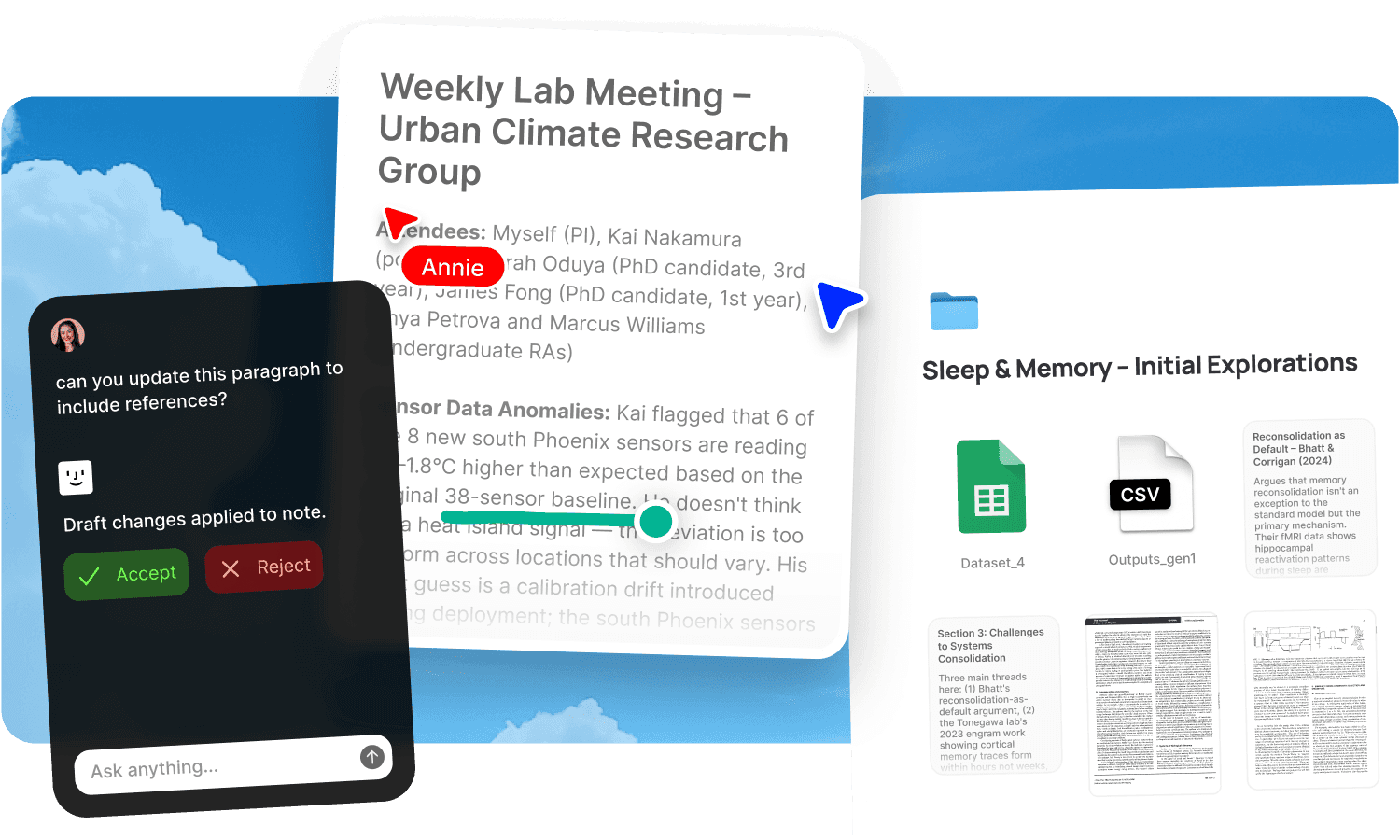
The AI assistant synthesises across sources. Ask it to summarise user sentiment about a feature, pull together every data point on a competitor's pricing, or find the meeting where the team decided to deprioritise a project. It draws on your full library, so the answer reflects everything you've collected, not just what you remember.
Decisions with evidence, not just opinion
Product decisions should be grounded in evidence: user research, data, competitive context, technical constraints. In practice, most decisions are made from whatever the PM can recall in the moment, because finding the supporting evidence takes longer than the meeting allows.
Fabric changes the equation. When you're writing a brief, the research is one search away. When someone challenges a prioritisation in a meeting, the user quotes that support it are findable in seconds. When a stakeholder asks "why did we decide that," the meeting transcript, the research summary, and the spec are all queryable.
Write specs, briefs, and strategy documents in notes and docs with your research library searchable alongside. The connection between a product decision and the evidence behind it stays intact because both live in the same workspace. Ask the AI assistant to pull together the relevant research as you draft, so the brief is grounded in data, not reconstructed from memory.
Meeting notes that feed the product record
PMs live in meetings. Standups, sprint planning, stakeholder reviews, customer calls, design critiques, leadership syncs. Each one generates decisions, context, and commitments that matter. Most of it evaporates because the notes are shorthand and the recording is unwatched.
Record every meeting with AI voice notes. The transcript lands in your workspace, searchable alongside specs, research, and notes. When you need to recall what was decided about the pricing change, search for it rather than scrolling through a backlog of meeting docs.
Create tasks and reminders from meeting action items so follow-ups are tracked alongside the conversation that created them. Forward relevant stakeholder emails to email-to-note so correspondence lives with the product record.
The meeting history becomes a searchable decision log without you maintaining a separate one.
Competitive and market context that stays current
Every PM tracks competitors and markets. Few do it in a way that's retrievable. You save an article, screenshot a feature page, note something from a sales call. Within weeks, the intelligence is scattered.
Save competitive material to Fabric and it stays searchable. AI search reads text inside screenshots. Ask "what does [competitor] offer for enterprise SSO" and find the screenshot, the feature comparison, and the call notes from a prospect who evaluated both products. The AI assistant can compare competitors on specific dimensions, summarise recent competitive moves, or identify gaps in your intelligence.
Over time, the competitive library compounds. New findings build on old ones. Patterns in competitor behaviour become visible. See competitive research and market research for the full workflows.
Use cases for product managers
The workflows PMs run in Fabric: capturing meeting notes from every standup and stakeholder call, maintaining project documentation that preserves product decisions, conducting research that stays searchable, tracking competitive research and market research with AI synthesis, brainstorming product direction on the canvas, building a team wiki for product processes and templates, and review and approval of specs and documents with annotations.
A product manager's day in Fabric
Morning. Before a roadmap review, you ask the AI assistant to pull together the user research findings, competitive context, and technical constraints relevant to the features under discussion. The briefing draws from transcripts, notes, and documents across the workspace. You walk into the meeting with evidence, not just opinions.
The meeting. You record the roadmap review with voice notes. The team debates two approaches and decides on one. The transcript captures the reasoning. You create tasks for the follow-up actions.
Mid-afternoon. You're writing a product brief for a new feature. You search "user complaints about notification settings" and get quotes from three interview transcripts, two support ticket summaries, and your own notes from a customer call. The brief is grounded in real user language.
Late afternoon. A designer shares an early exploration. You annotate directly on the mockup, pinning questions to specific elements. The feedback is spatial and specific, not a list of "the thing at the top."
End of day. You check the kanban for the current sprint. A sales rep forwarded competitive intel to email-to-note earlier. You save it to the competitive library. Next time someone asks about that competitor, it's already searchable.
Get started
Keep every spec, user insight, and decision in one searchable workspace and stop carrying the product's context in your head alone. Try Fabric free.
For user research workflows, see Fabric for user researchers. For team-wide knowledge management, see Fabric for startups. For individual founders managing product and company, see Fabric for founders.
FAQs
Can the AI surface user research when I'm writing a brief?
Yes. Search for any user topic and AI search finds relevant quotes, findings, and notes from across interview transcripts, call notes, and research documents. The AI assistant can synthesise the findings as you draft.
Can I search across meeting transcripts, specs, and research at once?
Yes. Search works across every content type in your workspace. A single query returns results from transcripts, specs, documents, emails, screenshots, and notes together.
Can I record and transcribe product meetings?
Yes. AI voice notes capture and transcribe any meeting. The transcript becomes a searchable part of the product record.
Can the AI recall why a past product decision was made?
Yes. If the decision was discussed in a meeting, written in a note, or captured in a document, the AI assistant finds the reasoning. It searches across the full history, not just recent documents.
Can I annotate design mockups with feedback?
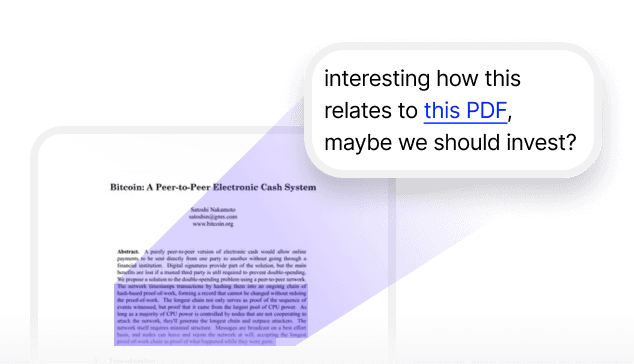
Yes. Annotations let you pin comments to specific spots on any image, PDF, or document. The feedback is contextual and attached to the design.
Can I track competitive intelligence over time?
Yes. Save screenshots, articles, and notes about competitors. AI search reads text inside images. Over time, the library becomes a searchable history of each competitor's moves. See competitive research.
Can I use kanban boards for sprint tracking?
Yes. Kanban boards let you organise work by stage with custom columns. Any folder can be switched to a kanban view.
Can I forward stakeholder emails into my workspace?
Yes. Forward any email to email-to-note and it becomes a searchable part of your product record alongside specs, meeting transcripts, and research.
Can the team collaborate on specs and briefs?
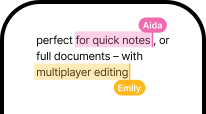
Yes. Notes and docs support real-time collaboration with live cursors, threaded comments, and @mentions. Write alongside the research the brief draws on.
Can I use the canvas for product thinking?
Yes. The canvas lets you spread problems, ideas, research, and specs spatially. Useful for mapping feature dependencies, planning a roadmap visually, or brainstorming product direction.
Can I use Fabric alongside Jira and Linear?
Yes. Fabric isn't a project management or issue tracking tool. It's the knowledge layer: specs, research, meeting records, competitive context, and decisions. Your PM tool tracks tickets. Fabric holds the reasoning and evidence behind them.
Is my product data secure?
Yes. Fabric uses AES-256 encryption, is CASA Tier 2 compliant, and does not use your data to train AI models. Product specs, user research, and competitive intel are private by default.
Can I import existing docs from Google Drive or Notion?
Yes. Fabric connects to Google Drive, Dropbox, and Notion. Bring in existing specs, research, and documentation without starting over.