Blog
The knowledge scaling problem
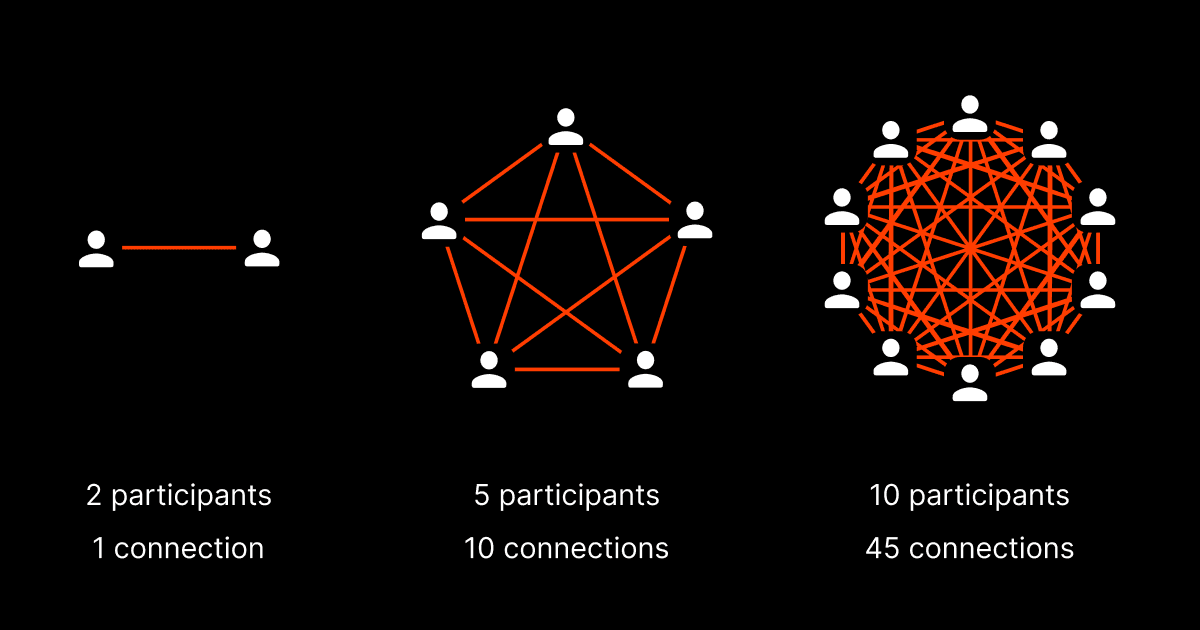
At five people, a team works beautifully. Everyone was in the room when the decisions were made. Everyone knows why the system is built the way it is. Everyone knows who's working on what. If you need to know something, you turn to the person next to you and ask. The whole team's knowledge fits in five heads, and because those five heads are in constant contact, the knowledge circulates naturally.
At fifteen people, cracks appear. New hires weren't in the room for the early decisions. The person who knows about the billing system is in a different timezone. Three people think the deployment process works one way and two people think it works another. Questions that used to be answered in thirty seconds now require a Slack thread and a fifteen-minute wait, because the person who knows the answer is in a meeting.
At thirty people, the model is broken. Engineers spend meaningful portions of their day figuring out who to ask rather than doing their work. Meetings exist primarily to share context rather than make decisions. Slack channels multiply as the team tries to create smaller circles where knowledge can circulate, but the effect is that important context ends up in channels that half the team doesn't follow. Someone who joined three months ago and someone who's been there since the beginning have such different mental models of the system that they're effectively working in different companies.
Why this happens
The underlying cause is mathematical rather than cultural, which is why no amount of "communication skills" training or "knowledge sharing" initiatives fixes it.
The number of one-to-one communication paths in a team grows with the formula n(n-1)/2, where n is the number of people. At 5 people, there are 10 possible paths. At 15, there are 105. At 30, there are 435. At 50, there are 1,225.
Knowledge that circulates through person-to-person communication has to travel across these paths to reach everyone who needs it. At 10 paths, this happens naturally through proximity and daily conversation. At 435 paths, it's physically impossible for the network to carry all the knowledge that everyone needs, so gaps form. The gaps are the cracks that teams start to feel at 15 people and that become structural constraints at 30.
Adding more communication channels (more meetings, more Slack channels, more all-hands updates, more standups) is the intuitive response, and it makes the problem worse rather than better. Each new channel adds noise to a network that's already overloaded with signal. The meeting that exists to share context takes an hour of everyone's time to transfer knowledge that three people actually needed. The Slack channel that was created to keep a subteam aligned becomes another place where context gets shared but not captured.
The problem isn't that people aren't communicating enough. The problem is that person-to-person communication is the wrong mechanism for knowledge transfer at scale.
What scales instead
Documentation scales linearly. A document that explains how the billing system works serves the fifth person to read it exactly as well as it served the first. It doesn't get tired, doesn't have office hours, doesn't require the reader to know which person to ask or whether that person is available. It serves 5 people and 50 people with the same effort, which is the fundamental property that person-to-person knowledge transfer lacks.
This is why well-documented teams maintain their velocity as they grow in a way that undocumented teams don't. The documentation absorbs the knowledge transfer load that would otherwise fall on the communication network, which means the network can carry the actually interactive communication (debates, decisions, creative collaboration) rather than being consumed by basic context transfer.
The practical question is whether the documentation stays current, because stale documentation is worse than no documentation: it adds a false signal to an already noisy network. This is where most documentation initiatives fail, because they require humans to maintain the docs alongside their actual work, and the maintenance is always the first thing deprioritised when the team is busy, which is exactly when current docs are needed most.
Removing the human bottleneck
The reason documentation typically fails to solve the scaling problem is that it introduces a new bottleneck: the humans who have to write and maintain it. The knowledge has to flow from the person who holds it, through a writing process, into a document, and then through a maintenance process that keeps the document current as things change. Each step in this chain is a point of failure, and the chain breaks reliably under the same pressure (growth, shipping speed, hiring) that creates the need for documentation in the first place.
Self-writing documentation removes the human from the writing step. The knowledge that's currently shared through Slack conversations, PR descriptions, and meetings is captured and structured automatically as it's created. The senior engineer who explains a design decision in Slack has now contributed to the documentation without doing anything beyond their normal work. The meeting where the team discusses a migration plan produces a document that anyone can read later without attending the meeting.
The maintenance step is handled the same way: as PRs are merged and conversations update the team's understanding, the documentation updates to reflect the current state rather than the state when someone last remembered to edit the wiki.
This changes the scaling dynamics fundamentally. The documentation stays current without human maintenance effort, which means it reliably absorbs the knowledge transfer load, which means the communication network isn't carrying that load, which means each new hire doesn't make everyone else slower.
The inflection points
If you're a leader of a growing team, there are three inflection points worth planning for.
10-15 people. This is when tribal knowledge starts failing. The team is too large for everyone to know everything through osmosis, but small enough that the pain is manageable. This is the cheapest moment to introduce documentation infrastructure, because the volume of knowledge to capture is still manageable and the habits you establish now will scale with the team.
20-30 people. This is when the pain becomes structural. Onboarding takes months instead of weeks. Senior engineers are spending significant time answering questions rather than doing deep work. Decisions get relitigated because the team doesn't have access to the reasoning behind past choices. If you haven't introduced documentation infrastructure by this point, the cost of the gap is already substantial and growing.
50+ people. At this scale, undocumented teams have typically adapted by creating layers of management whose primary function is context transfer: team leads who attend cross-team meetings, engineering managers who relay decisions between groups, knowledge brokers who exist because the information architecture doesn't. These roles are expensive and fragile (when the knowledge broker leaves, the knowledge goes with them). Well-documented teams at this scale don't need as many of these roles, because the documentation serves the context-transfer function that otherwise falls on people.
What this means in practice
The practical version of all this is less dramatic than the theory suggests. You don't need to overhaul how your team communicates. You need to ensure that the knowledge flowing through your existing communication channels is captured somewhere persistent and searchable, so that each piece of context shared once doesn't need to be shared again every time someone new needs it.
Connect your Slack, your GitHub, and your meeting recordings to a system that captures the knowledge they contain. Let the system build and maintain a wiki from those sources. Engineers continue communicating exactly as they do now, through Slack, PRs, and meetings. The difference is that the knowledge shared through those channels persists beyond the conversation and is searchable by anyone on the team at any time.
The team that sets this up at 10 people barely notices the benefit, because tribal knowledge is still working. The same team at 30 people will wonder how they ever operated without it, because the documentation is carrying the weight that the communication network can no longer support.
Frequently asked questions
We're only 8 people. Is this too early? It's the cheapest time to start. The volume of knowledge is small, the habits you establish will carry through growth, and by the time you need the documentation (which happens faster than you expect), it'll already be there. Retrofitting documentation at 30 people is far more expensive than growing it from 8.
Will this reduce the need for meetings? It should reduce the need for informational meetings, the kind that exist to share context or status. Decision-making meetings, creative collaboration, and team-building conversations still need to happen synchronously. But when the context is already documented and searchable, meetings can start from a shared understanding rather than spending the first twenty minutes establishing one.
How does this interact with remote and hybrid teams? Remote and hybrid teams feel the scaling problem earlier and more acutely, because they can't rely on physical proximity for knowledge circulation. An engineer in a different timezone can't tap someone on the shoulder to ask a question. Documentation that's comprehensive, current, and searchable is the primary mechanism for knowledge transfer in distributed teams, which makes the self-writing docs approach even more valuable.
What about company culture? Won't documentation make the team feel less connected? Documentation frees the communication network from carrying routine knowledge transfer, which means conversations can be about the things that actually build connection: creative discussions, problem-solving, debates, celebrations. The team doesn't feel less connected when they spend less time asking "who knows about X?" and more time doing the work they care about.
Related reading: The hidden cost of tribal knowledge, Good docs are a 10x engineering multiplier, The real cost of engineering onboarding, Documentation debt. Related pages: Self-writing docs, For engineering teams, Knowledge retention, Find anything.
Other blog posts:

The Creative's Cold Start Problem
How to Stop Losing Momentum Between Study Sessions
Your Future Self Can't Read Your Mind
The Hemingway Bridge: Stop Working So You Can Start Again

Your ERP Has the Answers. Nobody Can Find Them.
The Usability Layer Your Business Systems Are Missing
Handwritten vs Digital Notes: You Shouldn't Have to Choose
Why Your Handwritten Notes Are Unsearchable (And What to Do About It)